
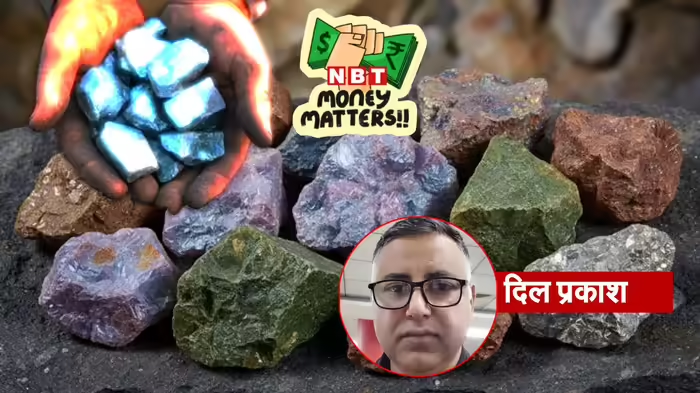

The global shift towards electric vehicles, battery storage, clean energy systems, and advanced grid networks has triggered an unprecedented surge in the demand for rare earth elements. However, China’s overwhelming control over this critical supply chain has become a strategic threat—not just for India, but for the entire Western world.
Recently, the Union Cabinet cleared a major policy decision aimed at reducing India’s dependence on China for rare earth materials. The new initiative seeks to accelerate domestic manufacturing of rare earth permanent magnets—an area where China has enjoyed unchallenged dominance for decades. With nearly 70% of global rare earth mining and 90% of refining capacity under its control, China’s monopoly has turned into a geopolitical weapon.
What Makes Rare Earths So Critical?
Rare earth elements are a group of 17 strategically significant metals, found in varying quantities in the Earth’s crust. Although deposits exist across several countries, the process of discovering, mining and refining these elements is expensive, technologically complex, and environmentally sensitive.
China understood this early. It invested heavily across the entire rare earth value chain—from exploration and extraction to refining and magnet manufacturing. Today, it reaps the strategic advantage.
Rare Earths: The ‘New Oil’
As clean energy technologies scale globally, rare earths are being called the “New Oil.” According to global estimates, the world possesses around 110 million metric tons of rare earth oxide, with major reserves in China, Brazil, India, Russia, the US, and Australia.
In 1993, global rare earth production was diversified:
- China – 38%
- USA – 33%
- Australia – 12%
- Malaysia & India – 5% each
But by 2008, China captured 90% of the world’s production. In 2011, its share hit 97%—cementing its unshakable dominance.
Western nations, especially the US, are now scrambling to break this grip, announcing new policies and partnerships. Yet, according to the International Energy Agency (IEA), China is likely to retain a strong hold on refining for many years to come.
Rare Earth Reserves Across Countries (Metric Tons)
- China: 44,000,000
- Brazil: 21,000,000
- India: 6,900,000
- Australia: 5,700,000
- Russia: 3,800,000
- Vietnam: 3,500,000
- United States: 1,900,000
- Others: 10,15,500+
Source: US Geological Survey
Rising Global Demand
Rare earths are essential for more than 200 high-tech products, including:
- Mobile phones
- Computer hard drives
- Electric & hybrid vehicles
- LCD/LED screens
- Solar technologies
- Wind turbines
- Defense systems (radars, lasers, guidance systems)
China recently tightened export controls on key minerals used in semiconductors and green technologies. Although some restrictions were later relaxed, the message was clear: Beijing will not hesitate to weaponize its dominance.
Can India Rise as a Rare Earth Power?
India holds substantial reserves but lacks adequate refining and magnet-manufacturing capacity. Over 90% of India’s rare earth magnet demand is still met through imports—primarily from China. Last year alone, India imported around 460 tons of neodymium-iron-boron (NdFeB) magnets.
Experts believe India will need 3–5 years to build a full domestic value chain if it receives:
- Strong policy support
- Financial incentives
- Public-private partnerships
- Investment in high-tech processing and refining
Developing local mining, establishing processing clusters, and supporting private manufacturers will be crucial for India to reduce dependence on China and emerge as a global alternative.
The Big Question
With rising geopolitical tensions, surging global demand, and China’s unpredictable export policies, the rare-earth crisis is becoming as critical as the global semiconductor shortage.
Can India step up as a reliable power and reshape the world’s rare-earth future?
The next few years will determine whether New Delhi seizes this opportunity—or continues to remain vulnerable to Beijing’s strategic leverage.
Related
Discover more from SD NEWS agency
Subscribe to get the latest posts sent to your email.
Discover more from World Pulse
Subscribe to get the latest posts sent to your email.