
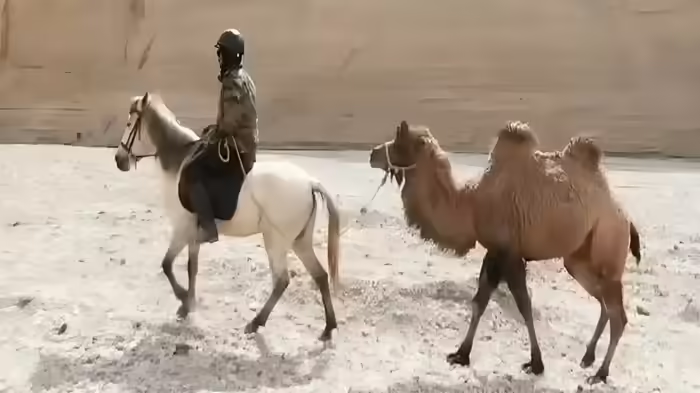
The Republic Day Parade 2026 is set to present a rare and striking spectacle on Kartavya Path, as the Indian Army will, for the first time, showcase double-humped Bactrian camels, Zanskar ponies, and specially trained anti-drone eagles. These unique assets will be part of the contingent of the Remount and Veterinary Corps (RVC), highlighting the Army’s reliance on indigenous animal strength in some of the harshest terrains in the world.
The RVC contingent will be led by Captain Harshita, marking another milestone for women officers in the Corps. The Indian Army began inducting women officers into the RVC around three years ago, and Captain Harshita belongs to its very first batch.
Bactrian Camels: Lifeline of Eastern Ladakh
Two double-humped Bactrian camels will march along Kartavya Path, symbolising the extreme operational challenges faced by Indian soldiers in Eastern Ladakh. These camels have been inducted as part of a recent initiative to strengthen logistics in high-altitude and cold desert regions.
Capable of operating comfortably at temperatures as low as minus 20 degrees Celsius and at altitudes ranging from 15,000 to 18,000 feet, these camels can carry loads of up to 200 kilograms. They are extensively used for transporting essential supplies to forward posts and for patrolling sandy and plateau-like terrain where vehicles cannot reach.
Beyond military utility, the initiative has also generated employment for local communities and contributed to the conservation of the rapidly declining population of double-humped camels in Ladakh.
Zanskar Ponies: Replacing Mules in Extreme Cold
The parade will also feature the Zanskar pony, a hardy indigenous breed increasingly being used by the Army in Eastern Ladakh. Known for their strength, endurance and low susceptibility to illness, these ponies are invaluable in high-altitude warfare.
Zanskar ponies can operate in temperatures plunging to minus 40 degrees Celsius and at heights of up to 18,000 feet, carrying loads of around 70 kilograms. They play a critical role in delivering rations and equipment and are also deployed for patrolling. The Army is gradually replacing mules with Zanskar ponies due to their superior adaptability to extreme terrain and weather.
Eagles Trained to Neutralise Drones
Adding a futuristic dimension to the parade, the RVC contingent will also include four trained raptors (eagles) capable of intercepting and bringing down enemy drones. Though not yet deployed operationally, these birds have been showcased during joint military exercises with foreign forces and are undergoing advanced training.
Working in coordination with canine soldiers, these eagles are envisioned as part of a layered anti-drone defence system. Their natural hunting instincts, powerful wings and sharp talons enable them to swiftly target airborne objects such as drones, making them uniquely suited for this role.
Indigenous Canine Soldiers on Display
The contingent will further feature 10 trained canine soldiers from indigenous Indian breeds, including Mudhol Hound, Rampur Hound, Chippiparai, Kombai and Rajapalayam, alongside conventionally trained dogs. These canines play vital roles in surveillance, tracking, guarding and combat support.
A Blend of Tradition and Innovation
This unprecedented display on Republic Day will not only celebrate India’s military heritage but also underline the Army’s innovative approach—blending traditional, indigenous resources with modern warfare requirements. From icy Himalayan heights to the ceremonial grandeur of Kartavya Path, the parade will offer citizens a powerful glimpse into the resilience, adaptability and ingenuity of India’s armed forces.
Related
Discover more from SD NEWS agency
Subscribe to get the latest posts sent to your email.
Discover more from World Pulse
Subscribe to get the latest posts sent to your email.